86. 区间列表的交集
给定两个由一些 闭区间 组成的列表,firstList 和 secondList ,其中 firstList[i] = [starti, endi] 而 secondList[j] = [startj, endj] 。每个区间列表都是成对 不相交 的,并且 已经排序 。
返回这 两个区间列表的交集 。
形式上,闭区间 [a, b](其中 a <= b)表示实数 x 的集合,而 a <= x <= b 。
两个闭区间的 交集 是一组实数,要么为空集,要么为闭区间。例如,[1, 3] 和 [2, 4] 的交集为 [2, 3] 。
难度:🌟🌟🌟
示例 1:
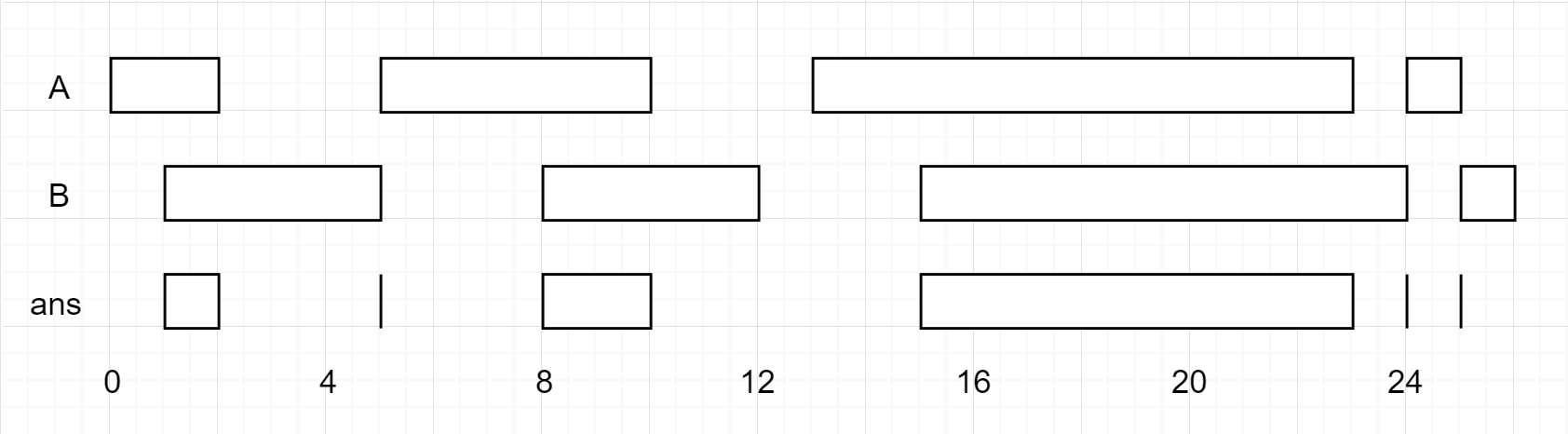
输入:firstList = [[0,2],[5,10],[13,23],[24,25]], secondList = [[1,5],[8,12],[15,24],[25,26]]
输出:[[1,2],[5,5],[8,10],[15,23],[24,24],[25,25]]
示例 2:
输入:firstList = [[1,3],[5,9]], secondList = []
输出:[]
示例 3:
输入:firstList = [], secondList = [[4,8],[10,12]]
输出:[]
示例 4:
输入:firstList = [[1,7]], secondList = [[3,10]]
输出:[[3,7]]
提示:
- 0 <= firstList.length, secondList.length <= 1000
- firstList.length + secondList.length >= 1
- 0 <= starti < endi <= 109
- endi < starti+1
- 0 <= startj < endj <= 109
- endj < startj+1
题解
我们用[a1, a2] 和 [b1, b2] 分别表示在 firstList 和 secondList 中的两个区间,使用 p1 和 p2 分别表示 [a1, a2] 和 [b1, b2] 下标。
当 a2 < b2 时,则计算交集,然后 p1 指向下一个区间;
否则,计算交集,然后 p2 指向下一个区间;
直到 p1 或 p2 有一个遍历到了数组末尾,循环停止。
代码实现
func intervalIntersection(firstList [][]int, secondList [][]int) [][]int {
	p1, p2 := 0, 0
	var res [][]int
	for p1 < len(firstList) && p2 < len(secondList) {
		a := firstList[p1]
		b := secondList[p2]
		if a[1] < b[1] {
			if intersection := calIntersection(a, b); intersection != nil {
				res = append(res, intersection)
			}
			p1++
		} else {
			if intersection := calIntersection(b, a); intersection != nil {
				res = append(res, intersection)
			}
			p2++
		}
	}
	return res
}

func calIntersection(a, b []int) []int {
	x1, y1 := a[0], a[1]
	x2, _ := b[0], b[1]
	if x2 > y1 {
		return nil
	}
	if x2 >= x1 {
		return []int{x2, y1}
	}
	// x2 < x1
	return []int{x1, y1}
}